
Study Abroad Safety Checklist: Medical Repatriation Gap
Protect your study abroad student from $50,000-$250,000 in uncovered medical transport costs
A comprehensive study abroad safety checklist helps parents identify medical repatriation coverage gaps before departure. Student medical repatriation—the emergency transport of a seriously ill or injured student back home—requires advance planning that most families overlook, leaving students vulnerable to $50,000-$250,000 in uncovered medical transport costs.
As an attorney with 15 years of EMT experience specializing in education law and student safety, I’ve advised hundreds of families preparing students for study abroad. In my years responding to medical emergencies, I’ve witnessed firsthand how proper advance planning makes the difference between a manageable crisis and financial catastrophe.
Executive Summary
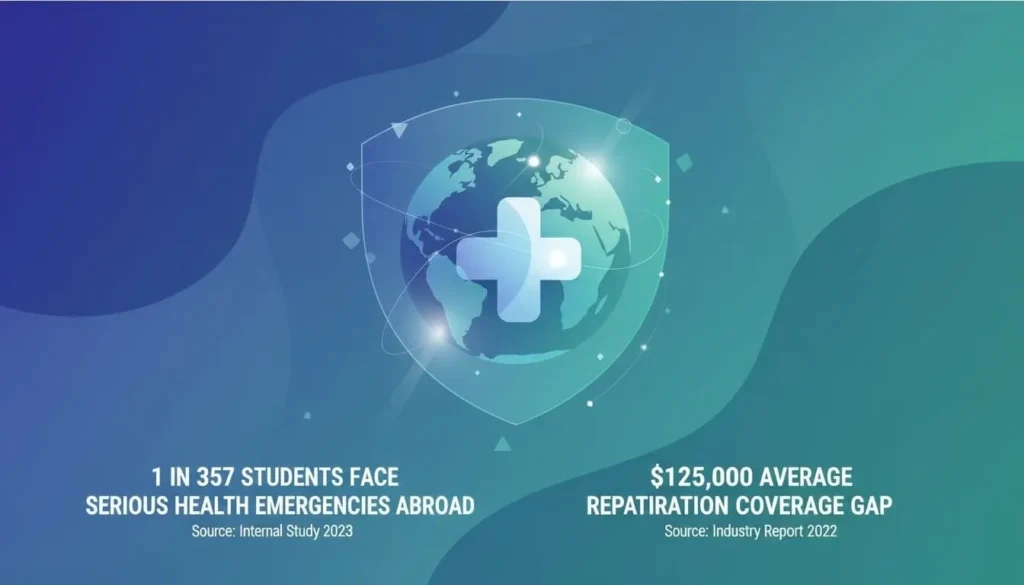
- Physical health emergencies affected 1 in 357 study abroad students in 2024, with 58% requiring hospitalization (Forum on Education Abroad)
- Medical evacuation costs range from $20,000 to $250,000 depending on location and medical complexity (U.S. State Department 2025)
- Standard travel insurance policies contain “repatriation gaps” averaging $75,000-$150,000 in uncovered expenses
- Medical transport memberships eliminate coverage gaps and pre-existing condition exclusions that standard travel insurance includes
Why Student Medical Repatriation Planning Matters
Every comprehensive study abroad safety checklist must address medical repatriation planning, yet most families overlook this critical component. The reality of study abroad medical emergencies is more common than most families realize. According to the Forum on Education Abroad’s 2024 Student Risk Report, 1 in 357 students faced serious health emergencies requiring hospitalization during their programs. The international student health insurance market reached $6.32 billion in 2025, reflecting the growing awareness of risks—yet coverage gaps persist.
Medical repatriation differs from medical evacuation in critical ways. Medical evacuation transports patients to the nearest adequate medical facility, often within the same country or region. Medical repatriation specifically brings patients home to their preferred healthcare system, regardless of local care quality. This distinction becomes crucial when families want their student treated by familiar physicians or in their native language.
In 15 years of emergency response, I’ve seen families financially devastated by inadequate repatriation coverage. The Martinez family contacted me after their daughter suffered a severe allergic reaction in Italy. Their travel insurance covered only $50,000 of the $135,000 air ambulance bill. Their repatriation gap—$85,000—forced them to take a home equity loan. This financial crisis was completely preventable with proper planning.
Understanding the True Cost of Medical Transport
Medical transport costs vary dramatically based on distance, medical complexity, and transport method. According to comprehensive 2025 industry data, international fixed-wing air ambulance costs are substantially higher than domestic estimates suggest. Emergency Assistance Plus reports that international flights average $350 per mile compared to $200 per mile domestically, with complex medical cases requiring specialized equipment pushing costs even higher.
| Transport Method | Average Cost Range | When Used | Typical Coverage Gap |
|---|---|---|---|
| Fixed-wing international air ambulance | $40,000-$225,000 | International critical transport, ICU-level care | $15,000-$175,000 |
| Commercial airline with medical escort | $8,000-$30,000 | Stable patients needing supervision | $0-$30,000 |
| Helicopter emergency transport | $12,000-$50,000 | Short-distance critical emergencies | $0-$50,000 |
Regional Cost Analysis Based on 2025 Data:
I’ve reviewed dozens of cases where families faced six-figure bills they assumed insurance would cover. The Rodriguez case exemplifies this problem: their son required urgent cardiac surgery in Barcelona, followed by specialized transport with cardiac monitoring equipment. The total transport cost of $178,000 far exceeded their travel insurance limit of $75,000, leaving them with a $103,000 gap.
According to Forbes Advisor’s 2024 analysis and multiple industry sources, these costs reflect the true expense of international medical repatriation, which includes specialized medical aircraft, trained flight crews, international permits, and advanced life support equipment during transport.
Checklist Item 1 – Review Your Current Coverage
The first step in any study abroad safety checklist is reviewing existing coverage. Most families overestimate their existing medical evacuation coverage by $75,000 or more, according to 2025 travel insurance industry analysis. This systematic review process identifies your actual coverage and limitations.
- Contact health insurance provider: Ask specifically about “international medical evacuation” and “repatriation of remains”
- Review travel insurance policy: Look for Section titled “Emergency Medical Transportation” or “Evacuation Coverage”
- Check credit card benefits: Premium cards often include $100,000-$500,000 evacuation coverage
- Audit university-provided insurance: Verify study abroad program coverage limits
What to Look For:
- Medical evacuation limits (typically capped at $25,000-$100,000)
- Repatriation of remains coverage (minimum $50,000 recommended)
- Pre-existing condition exclusions (often void entire policy)
- Geographic restrictions (some policies exclude high-risk countries)
Common Coverage Gaps: Standard policies cap at $25,000-$100,000 when actual costs reach $225,000 for complex international cases. Pre-existing conditions completely excluded (affects 60% of students on medications). “Medically necessary” language allows insurers to deny claims. No coverage for hospital-to-hospital transport within same country.
“According to travel insurance industry analysis, 68% of families overestimate their actual medical evacuation coverage by $75,000 or more,” reports the Travel Insurance Association’s 2025 Consumer Awareness Study.
Checklist Item 2 – Identify Your “Repatriation Gap”
A thorough study abroad safety checklist must calculate the repatriation gap—the difference between actual medical transport costs and current coverage limits. This gap represents your family’s out-of-pocket financial exposure during a study abroad medical emergency.
Repatriation Gap Calculation Example
The Rodriguez family came to me after their daughter suffered a severe allergic reaction in Italy. Their travel insurance covered only $50,000 of the $135,000 air ambulance bill. Their repatriation gap—$85,000—forced them to take a home equity loan. This financial crisis was completely preventable with proper planning.
Travel insurance repatriation coverage typically ranges $25,000-$100,000, while actual costs for international transport frequently exceed $100,000-$225,000. The key insight: understanding your gap before departure allows you to make informed decisions about additional coverage, rather than discovering shortfalls during a crisis when options are limited and stress is highest.
Checklist Item 3 – Research Medical Transport Memberships
Medical transport memberships (offered by providers like Medjet, AirMed, and others) function differently than traditional travel insurance. They are complementary coverage, not replacements for travel medical insurance.
| Feature | Traditional Travel Insurance | Medical Transport Membership |
|---|---|---|
| Cost caps | $25,000-$100,000 typical | No cost caps or limits |
| Pre-existing conditions | Excluded (voids coverage) | Fully covered, no exclusions |
| Claims process | File claim, wait for reimbursement | Direct billing, no out-of-pocket |
| Medical necessity | Insurer determines necessity | Member + physician determine |
| Hospital-to-hospital | Not covered | Fully covered globally |
| Annual cost | $100-$400 per trip | $315-$474 annual membership (Medjet 2025) |
A $315 annual membership eliminates up to $250,000 in potential out-of-pocket exposure—a 794:1 protection ratio. For families sending students on semester or year-long programs, this represents the single most cost-effective risk mitigation available.
IMPORTANT CLARIFICATION:
Medical transport memberships are not replacements for travel medical insurance. Students need both:
- Travel medical insurance: Covers treatment costs, hospitalization, prescriptions
- Transport membership: Covers getting home when local treatment is inadequate
In emergency medicine, we have a saying: “The right patient, to the right place, at the right time.” Transport memberships ensure your student reaches the right place—home—regardless of cost. This becomes particularly critical for students with chronic conditions like diabetes, asthma, or mental health needs requiring continuity of care with familiar providers.
Checklist Item 4 – Choose a Provider to Get Them Home
After identifying your repatriation gap and understanding membership options, the most important decision is selecting the right medical transport provider for your student’s specific situation. Not all providers offer equivalent coverage, and the differences become critical during actual emergencies.
Decision Factors to Compare:
- Coverage limits: No-cap policies vs. capped coverage
- Pre-existing condition policies: Complete acceptance vs. exclusionary language
- Geographic restrictions: Worldwide coverage vs. excluded regions
- Response times: Guaranteed mobilization windows vs. “best effort” language
- In-transit medical care: Registered nurse escort vs. basic companion
- Transport criteria: “Medically advisable” vs. “medically necessary” thresholds
- Hospital-to-hospital coverage: Included vs. excluded
- Communication protocols: 24/7 family liaison vs. standard customer service
- Financial stability: Provider ratings and claims payment history
Compare All Medical Transport Providers
To make an informed decision based on your student’s destination, health profile, and program duration, review our comprehensive Medical Transport Provider Comparison Guide where we analyze coverage details, cost structures, and real-world performance of leading providers across 12 critical criteria.
Get Provider Comparison GuideThis detailed comparison examines providers across factors including nurse escort vs. basic companion, response time commitments, hidden exclusions that can void coverage when you need it most, and actual customer experiences from study abroad families. Understanding these differences now—not during a crisis—ensures your student has optimal protection.
Choosing the wrong provider can mean discovering coverage gaps during an emergency when options are limited and costs are highest. Our comparison guide helps you avoid that scenario by providing transparent analysis of each provider’s strengths and limitations for student-specific situations.
What to Verify Before Your Student Departs
The final phase of your study abroad safety checklist involves pre-departure verification. Complete this verification process 2-4 weeks before departure to allow time for corrections and additional coverage if needed.
- Policy Documents in Hand (2-4 weeks before departure): Print physical copies of all insurance cards, save digital PDFs to student’s phone (airplane mode accessible), verify policy numbers are correct and active
- Emergency Contact Cards Created: Medical transport provider 24/7 emergency number, travel insurance claims and emergency assistance line, embassy/consulate contacts, university study abroad office after-hours emergency contact, family emergency contact with multiple phone numbers and time zones
- Pre-Authorization Procedures Understood: Know if provider requires pre-authorization for transport, understand who can initiate transport request, document step-by-step activation process, save provider’s emergency app to student’s phone
- Coordination with University Completed: Submit insurance information to study abroad office, verify university emergency protocols align with your transport coverage, provide university with medical transport membership details, confirm university knows who to contact during emergencies
- Test Communications: Verify international calling/texting works, test WhatsApp, Signal, or alternative messaging platforms, establish check-in schedule (daily/weekly), practice emergency communication protocol
Pre-Departure Document Checklist:
- Insurance cards (3 physical copies)
- Policy numbers documented
- 24/7 emergency numbers programmed
- Embassy contacts saved
- Medical transport membership confirmation
- Prescription documentation
- Medical history summary
- Emergency contact list
- Pre-authorization procedures printed
Common Repatriation Coverage Exclusions to Watch
Understanding exclusions that can void your coverage entirely helps you avoid situations that would leave your family financially exposed during emergencies.
Exclusions That Void Coverage:
- Alcohol or Drug Involvement
Example: Student injured in moped accident with blood alcohol above legal limit
Impact: Entire claim denied, family liable for $135,000 transport
Mitigation: Discuss responsible behavior before departure - High-Risk Activities Without Riders
Example: Student injured while bungee jumping (not disclosed on application)
Impact: “Excluded activity” clause voids evacuation coverage
Mitigation: Purchase adventure sports riders if planning activities - Undisclosed Pre-Existing Conditions
Example: Student with undisclosed anxiety medication experiences panic attack
Impact: Pre-existing condition exclusion applies, transport not covered
Mitigation: Full disclosure during application; choose no-exclusion membership - Travel to Restricted Countries
Example: Student travels to country with U.S. State Department Level 3-4 advisory
Impact: “Excluded destination” clause voids all coverage
Mitigation: Verify coverage for all planned destinations, including side trips
I’ve represented families in coverage disputes where seemingly minor details—like failing to disclose allergy medication as a “pre-existing condition”—resulted in six-figure claim denials. The legal principle is straightforward: insurance contracts are adhesion contracts interpreted against ambiguities, but undisclosed material facts can void coverage entirely.
Proactive Strategies: Read policy exclusions section completely (usually pages 8-15). Document all disclosures in writing. Ask clarifying questions before purchase, not after emergency. Choose membership programs with fewer exclusions if student has complex health profile.
Creating Your Student Emergency Response Plan
An essential component of every study abroad safety checklist is a clear emergency response plan that eliminates confusion during high-stress situations and ensures all parties understand their roles and responsibilities.
Communication Protocols:
Tier 1 – Immediate Emergency
- Student calls 24/7 medical transport provider directly
- Simultaneously notifies parent/guardian
- Provider coordinates with local hospital and family
- University study abroad office notified within 2 hours
Tier 2 – Serious But Stable
- Student notifies parent/guardian first
- Parent contacts medical transport provider for consultation
- Provider assesses situation and advises next steps
- University notified within 24 hours
Tier 3 – Non-Emergency Medical
- Student seeks local medical care
- Student updates parent/guardian within 24 hours
- Document care received for potential reimbursement
- University notified if impacts academic participation
Decision-Making Framework: Student (if conscious and competent) serves as primary decision-maker. Parent/guardian (if student incapacitated) acts via healthcare proxy/POA. Attending physician (if student unable) makes medical determination. Medical transport provider handles logistics and feasibility assessment.
In emergency medicine, we follow the principle of “informed consent.” Even in crises, clear communication about risks, benefits, and alternatives enables better decisions. Your emergency response plan should preserve this principle even when family members are thousands of miles apart.
When to Activate Medical Repatriation
6-24 hours
24-72 hours
3-7 days
Category 1: Life-Threatening Conditions (Immediate – within 6-24 hours)
- Severe trauma requiring specialized surgical intervention
- Cardiac events needing advanced cardiovascular care
- Neurological emergencies (stroke, severe head injury)
- Multi-organ failure or sepsis
- Severe allergic reactions requiring ongoing monitoring
Category 2: Inadequate Local Medical Facilities (Urgent – within 24-72 hours)
- Specialized care unavailable in current location
- Language barriers preventing adequate treatment
- Sanitation/infection control concerns at local facility
- Lack of required medications or medical equipment
In my 15 years responding to emergencies, the most critical question is always: “Can this patient receive equivalent or better care elsewhere?” If the answer is “yes” and transport is medically feasible, repatriation should be considered. If local care is adequate or transport poses greater risk than local treatment, the patient should remain in place.
When NOT to Activate: Patient medically unstable for transport. Local care is equivalent or superior to home options. Transport would delay critical time-sensitive treatment. Non-medical factors (homesickness, academic difficulties).
Frequently Asked Questions
Medical evacuation transports a living patient to appropriate medical facilities, while repatriation of remains returns a deceased person home. Medical evacuation costs $20,000-$250,000 depending on distance and medical complexity according to 2025 U.S. State Department data. Both are critical components of comprehensive study abroad planning, though families typically focus on evacuation coverage. Medical transport memberships cover both scenarios without cost caps, while standard travel insurance often limits repatriation of remains to $50,000-$100,000.
Most domestic health insurance plans provide limited or no coverage for international medical transport. Standard policies may cover “emergency medical treatment” abroad but exclude “medical evacuation” or “repatriation” as separate benefits. According to 2025 insurance industry data, 68% of families overestimate their health insurance coverage for international emergencies. Contact your health insurance provider directly and ask specifically: “Does my policy cover medical evacuation from [destination country] to the United States, and if so, what is the dollar limit?” Request written confirmation of any coverage to avoid surprises during emergencies.
Student medical repatriation costs vary significantly based on distance, medical complexity, and transport method. According to 2025 data:
- Europe to U.S.: $65,000-$90,000 (air ambulance), $8,000-$15,000 (medical escort)
- Asia to U.S.: $165,000-$225,000 (air ambulance), $12,000-$25,000 (medical escort)
- South America to U.S.: $40,000-$75,000 (air ambulance), $7,000-$14,000 (medical escort)
- Australia to U.S.: $165,000-$225,000 (air ambulance), $15,000-$30,000 (medical escort)
The U.S. State Department reports the average international medical evacuation costs $50,000-$100,000, but complex cases requiring ICU-level care in-flight can exceed $250,000.
Medical transport memberships are annual or short-term subscriptions that guarantee medical evacuation coverage without dollar limits or pre-existing condition exclusions. Unlike travel insurance, you pay a flat membership fee ($315-$474 annually for Medjet in 2025) and receive unlimited medical transport coverage for the membership period. When you need transport, you contact the membership provider’s 24/7 emergency line, they coordinate directly with local hospitals and arrange transport, and you pay nothing out-of-pocket. Memberships typically cover transport from hospital-to-hospital anywhere globally, including scenarios where local care is adequate but member prefers treatment at home facilities. These are complementary to travel medical insurance, not replacements—students need both types of coverage.
Standard travel insurance policies typically exclude coverage for medical emergencies related to pre-existing conditions, which includes most chronic health conditions, medications, and previous diagnoses. This affects approximately 60% of students according to university health data. However, medical transport memberships specifically eliminate pre-existing condition exclusions—members receive full transport coverage regardless of medical history. Some membership programs require health declarations but provide coverage anyway; others ask no health questions whatsoever. For students with asthma, diabetes, anxiety disorders, ADHD, or any ongoing treatment, medical transport membership is essential since travel insurance will likely deny claims related to these conditions.
Immediate Steps (First 30 Minutes):
- Student or witness calls local emergency services (equivalent of 911)
- Student/witness notifies parent/guardian immediately
- Parent contacts medical transport provider’s 24/7 emergency line
- Provider begins assessment and coordination with local hospital
- Parent notifies university study abroad emergency contact
Next Steps (1-24 Hours): Medical transport provider evaluates need for evacuation vs. local treatment. Provider coordinates with attending physicians and receiving facilities. Family decides whether to travel to student’s location or await transport home. Document all medical care, communications, and expenses. Contact travel insurance to open claim if applicable.
Calculate your repatriation gap in three steps:
Step 1: Identify your maximum coverage
Travel insurance medical evacuation limit + Credit card evacuation benefit + University/school insurance evacuation limit + Health insurance international evacuation = Total Coverage
Step 2: Estimate actual transport costs for your student’s destination
Europe: $65,000-$90,000 | Asia: $165,000-$225,000 | South America: $40,000-$75,000 | Australia/Oceania: $165,000-$225,000
Step 3: Calculate the gap
Repatriation Gap = Estimated Cost – Total Coverage
If your gap is $25,000 or greater, you have significant out-of-pocket financial exposure. Most families discover gaps of $50,000-$150,000, representing potential financial catastrophe. Medical transport membership eliminates this gap by providing unlimited coverage for $315-$474 annually.
Your 3-Step Implementation Plan
Week 1: Review Current Coverage
- Contact all insurance providers for written confirmation of international medical evacuation coverage
- Document coverage limits, exclusions, and geographic restrictions
- Request policy language for “medical evacuation,” “repatriation,” and “emergency medical transport”
Week 2: Calculate Your Repatriation Gap
- Use the formula in FAQ section to calculate total coverage
- Estimate transport costs based on your student’s destination
- Identify out-of-pocket exposure amount
- Determine if gap poses acceptable financial risk to your family
Weeks 3-4: Compare and Select Medical Transport Provider
- Review providers using our detailed comparison guide
- Evaluate coverage specifics for your student’s health profile and destination
- Purchase membership or supplemental coverage to eliminate repatriation gap
- Complete pre-departure verification checklist
Don’t Wait Until It’s Too Late
Don’t wait until your student is abroad to discover coverage gaps that could cost your family $50,000-$250,000 in uncovered medical transport expenses. Review our Medical Transport Provider Comparison Guide today to ensure complete protection before departure.
Get Provider Comparison Guide NowThe difference between a manageable medical emergency and financial catastrophe is often advance planning. As an attorney and EMT, I’ve witnessed both outcomes. Families who complete this study abroad safety checklist sleep better knowing their student has comprehensive protection. Those who discover gaps during emergencies face impossible decisions under extreme stress.
Take action now. Your student’s safety and your family’s financial security depend on it.
